Carol’s Column
Oh death where is thy sting?
THE sad strains of Chopin’s funeral march wafted over the silent garden.
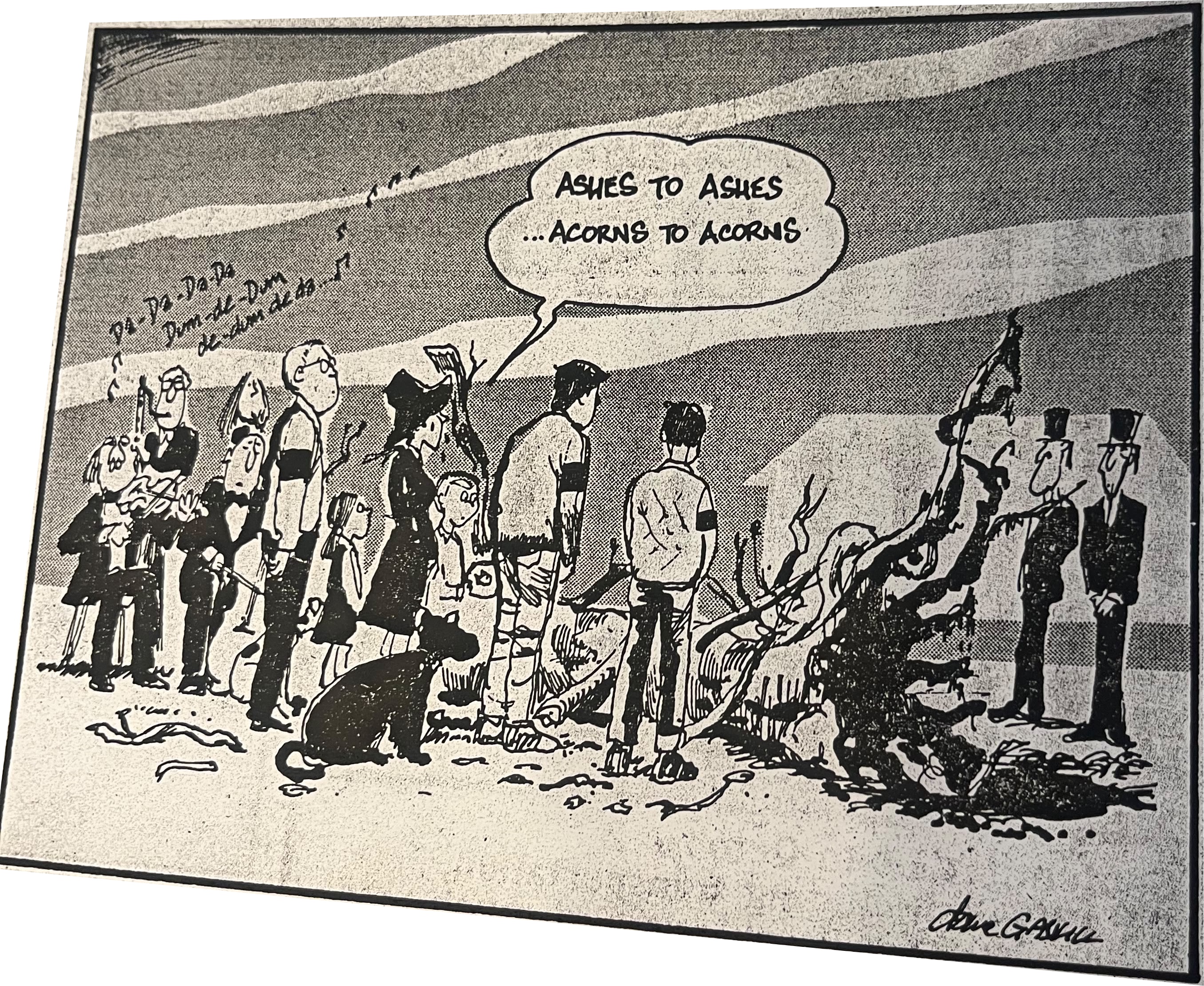
The leaves had stopped rustling and the grass roots were still. Even the snails had stopped crawling.
It was a tragic, solemn moment.
I felt a tear squeeze out of my right eyeball, trickle down my cheek and drop on to my pink-suede boots.
“This is ridiculous,” muttered my husband, standing stiffly to attention, his chins quivering in the breeze.
I glared at him, stark tragedy etched on my face.
“You have no heart,” I whispered fiercely, “no soul.”
He was unrepentant. “This is absolutely ridiculous,” he reiterated. “Who’s ever heard of having a funeral for a tree?”
“A tree?” I hissed. Whenever I’m upset I hiss, you understand. “She was not a tree, she was an oak.”
My husband scowled back. “Oaks are males,” he said, “stout and strong.”
“Courageous, brave — they’re female,” I whispered.
There was silence.
Of course, anyone casually passing might have wondered why two adults, four children, three dogs, one cat and a goldfish were weeping uncontrollably on the front lawn over a pile of dead branches.
I must admit, there were times when I wondered myself as the wind howled about my ears and my kneecaps froze.
Finally the service was over and we trooped inside to enjoy a traditional wake of toasted currant buns and cocoa laced with brandy to dissipate the chill.
The hole in our lives caused by the untimely passing of our oak tree was great.
In fact, it was so great that we could now see the unwelcome sight of the neighbours to whom we hadn’t spoken for 15 years.
We could also see directly into the Hall’s bathroom.
“Jamie, dismantle that telescope immediately,” I heard my older son remarking to his younger brother, “use binoculars instead, they’re less obtrusive.”
We sat and reminisced for the oak had been part of our lives for 16 years. Indeed, she’d been at least 80 or 90 years old when we’d first moved into our house.
And over 16 years, there were many memories.
“Do you remember the treehouse Warwick and I built?” said Jamie, his voice suitably subdued. “Warwick refused to come down and we called the fire brigade to pluck him from the branches.”
Could I ever forget?
“Then there was the time Richard Stevens fell out of the tree. Do you remember?”
Could I forget? I’d just climbed into a perfumed bath with Robert Ludlum when I heard a frantic cry: “Ma, Ma, come quickly, Richard has fallen out of the tree and he’s dead!”
Like greased lightning I’d flown to the foot of the oak to find Richard limp and still. Fortunately, although his wrist was broken, he was only stunned.
□ □ □
However, the neighbours had never recovered from the sight of a middle-aged mother of four leaping around the garden, starkers and steaming from the bath.
For years Ralph and Jamie used our oak as a fort from which they pelted Mr Caithness’s house with eggs.
To this day Mr Caithness believes there are birds that fly over from Zoo Lake with a penchant for raw eggs.
The oak had a resident colony of birds who were with us for years.
The raucous, bald-headed Indian mynah I’d mistaken for a Cape vulture, a magnificent, rainbow-plumed hoopoe, the warbling crested barbets not to mention a masked weaver.
We called him Willie and each spring he’d deplete the branches of leaves and build his several dwellings which he’d offer to his wife and she’d systematically reject until she was totally satisfied.
I’d admired her for years and pointed her out to the family as a bird who knew her mind.
My spouse was singularly unimpressed. “She’s a kugel,” he’d remarked, “if she’s not renovating, she’s unhappy. Just watch, soon she’ll be demanding an architect-designed nest with cantilevering, a jacuzzi and a sauna.”
But best of all was spring when shoots bloomed and within a week our oak would be a burst of fresh green.
And then, last year, tragedy struck.
The leaves were wrinkled and dead-looking. “She looks a little like you,” remarked my husband when I pointed them out to him.
I called the tree doctor. He examined her carefully, then spoke gravely: “Your oak has blight. She’s in a bad way, in fact it’s questionable whether she’ll last the season.”
We tried everything. Spraying, antibiotics, massage, and, as a last, desperate resort, chicken soup without kneidels (kneidles cause flatulence). It was all in vain.
Last week, we noticed her trunk beginning to split. Her branches were gnarled, leafless.
“You can see she’s in agony,” I said to my husband.
“Euthanasia,” he replied. “It’s the only thing. It’s kinder to put her out of her misery.”
We could only all agree.
But — when you go, you should go in style, which is why we’d decided upon a funeral and a wake.
“Did you enjoy the music?” I asked my husband as we sipped the hot cocoa.
“Sure, sure, very appropriate. But was it really necessary to hire the SABC orchestra?”
“Well, I wanted only the best for her. When you expire, I’ll fly in the London Philharmonic.”
It’s little touches like this that keep a marriage going.
Yes, it’s been a sad week.
But, only yesterday, while fertilizing the hole prior to planting, I noticed a tiny green shoot.
There was no doubt, it was a baby oak. “Hey, our oak’s given birth, we’ll soon have another oak — just 50 years or so!” I couldn’t contain my joy.
“That’s great,” remarked my daughter, “but, Ma, I never knew she was married!”
Have you ever tried to explain the sex life of an oak tree to a 10-year-old?
■
Editorial note
Masthead reads Sunday Express LIVING, May 22, 1983, page 5. Drawing preserved from the separate close-up, page-447, with the Gaskill signature and caption. The lower left frame edge runs outside that photograph. The two spellings kneidels and kneidles follow the clipping. This is a different column from the identically titled November 18, 1979 article.