Carol’s Column
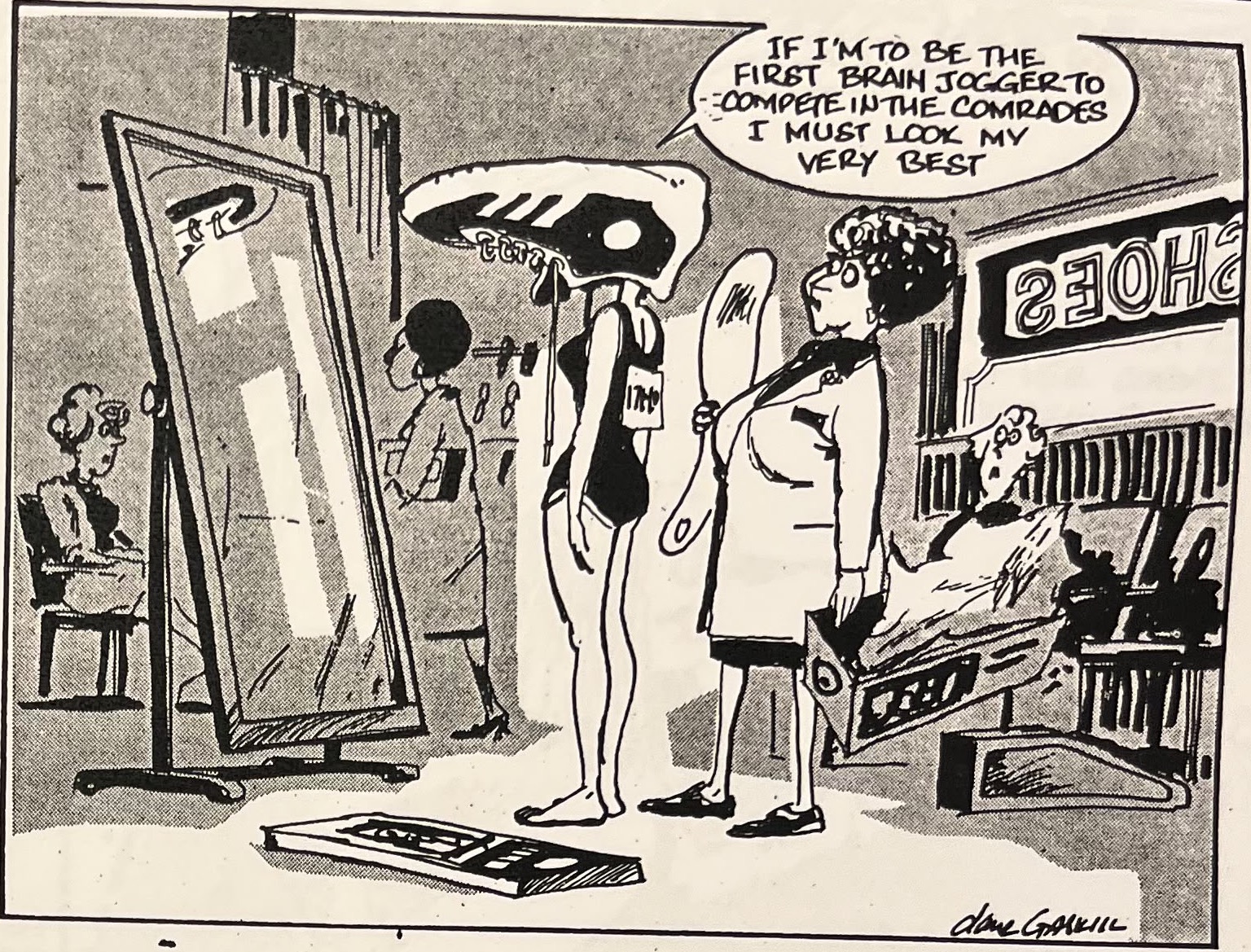
When jogging goes to Carol’s head
THERE'S jogging and jogging.
I mean, personally, I think all joggers are mad.
You see them in their thousands, legs pumping, chests heaving and wheezing, eyes glazed, and arches aching, running along the winding Zoo Lake pathways.
Relentlessly they run, through the mud and dog plops, never pausing.
Aah — it's a sight to see.
Quite revolting.
And now, to make matters worse, there's a new kind of jogging rearing its head.
Called 'brain jogging' it's the latest discovery of a team of on-the-ball scientists at a cybernetics institute in Paderborn, West Germany.
No, cybernetics is not a new citrus cold drink, nor is it a flashy underarm deodorant or a venereal disease.
It is in fact the study of the system of control and communications in living organisms and electrically operated devices such as calculators.
Now, these experts maintain that if you jog your brain regularly — several times a day — it will boost your life expectancy.
In fact, with a well-jogged brain, you could live to a ripe old age.
All that is needed is to keep your little grey cells active and alert by exercising them.
Doing sums, crossword puzzles or even adding up your supermarket bills mentally, will stimulate your brain and keep those cells jogging.
I thought of all this as I looked at myself in the mirror only the other morning.
Oh, it wasn't easy finding the mirror, believe me. My wrinkle-away coldcream had splotched right across my tear ducts and the steam from the bath caused the mirror to mist over.
I wiped a space and peered at my brain. Like the rest of me, it looked horrible.
Ja, there was no doubt that a jog or two could only do it good.
I thought of those 127 German hospital patients who'd been tested for two years and had come out with renewed zest and energy. Well, there was no way I could pop over to Paderborn for a year or two.
What with the school lifts, curtain hems to be straightened, home-made muesli to be made, banana bread to be baked and the piston rings on my car to be replaced, there wasn't time to take a year off.
No, I'd have to jog my brain in Parkwood.
It's difficult though. How does one actually go about jogging a brain?
I phoned my good friend Betty.
“I've got a problem,” I said to her.
“Rob's run away with a belly dancer,” she said immediately.
“That wouldn't be a problem — that would be a pleasure,” I retorted with some asperity.
“You're not feeling happy,” she said. “I can tell by the tone of your voice.”
A perceptive person, my friend Betty.
“Listen,” I said, “my brain is atrophied, my life expectancy is diminished and I need a course of mental cybernetics.”
“Mental cybernetics? Well, why don't we go and see a James Bond movie? No? OK, I'll think of something else as soon as I come back from taking Gaby and Leora to a pyjama party in Ogies and dropping David at karate.”
It's tough being a mother. I could see Betty was preoccupied — but that didn't solve my problem.
My own family were equally unhelpful.
“Ma,” said Ralph, “there's nothing wrong with your brain. It's fine the way it is. So, it's a little slow, a little rusty, a little worn. Does it matter? You can't go off to Paderborn — who'll make the school sandwiches?”
I'd reached the depth of mental despair, when an advertisement in the local suburban newspaper caught my eye. 'Live Longer — Jog Your Brain' it proclaimed.
Underneath were details about a course proceeding that very night at the Parkwood Recreation Club.
I punctured my bicycle wheel so arrived at the meeting 10 minutes late.
The small room was crowded.
I slipped silently into the back row sitting between two other potential brain joggers.
And tried to hear what the lecturer, a dynamic, assertive walrus of a young man, was saying, but it was difficult due to the noise on either side of me.
My neighbour on the left, who must have been 93 at least, was wheezing and clicking his teeth together while the neighbour on my right, a sparrow-faced duck of 80 or thereabouts, twittered, grunted and snorted.
I glanced around surreptitiously. Other than me, there was not a potential brain jogger under the age of 70. Indeed, the lecture room looked like God's waiting room.
The lecturer proceeded to put us through a practical course of brain jogging. It was exciting, invigorating — I could feel my brain cells regenerating themselves.
There was no doubt, at this rate I'd make a century.
Just then, while participating in a particularly strenuous mental exercise, the gentleman on my left twitched vigorously a few times and then sat still. Totally still.
His wheezing had stopped as had his teeth clicking.
I looked closely. Good heavens, he'd died.
Talk about brain jogging — my brain had stopped in shock.
I screamed “he's dead!” causing much agitation in the small room.
There was a scurry and a flurry as they grabbed my neighbour and tried to revive him.
And then as I poured cold ginger beer over his wizened head, he opened his eyes: “What's happening? What's happening?” he shouted querulously.
“Dead? Of course I'm not dead.”
There was chaos.
Slowly, I slipped away into the night.
The experience had shaken me.
As I wheeled my bike up the driveway, Ralph opened the front door.
“Hi, Ma,” he said, “so how're the brain cells? Did you enjoy the brain jogging session? Have you boosted your life expectancy?”
“Boosted my life expectancy? I've just lost 10 years,” I gasped as I made my way slowly upstairs.
Sometimes you just can't win.
■
Editorial note
Masthead reads Sunday Express LIVING, February 5, 1984, page 5.