Carol’s Column
How not to get into a stew
I RECAPTURED my childhood the other day.
While dashing through the supermarket, fist bent and skirts flying, I suddenly came upon it.
Lying between the dogfood and the soap. Waterblommetjies.
The trolley screeched to a halt — there, in small plastic packets, lay the stuff that dreams are made of. Waterblommetjies.
I shut my eyes and thought of days long past. Of my grandmother.
My thoughts immediately became Technicolor — that's the kind of effect my grandmother still has on me, even today, while she floats around in heaven cooking delicious bredies and running everyone from God downwards.
My maternal grandmother was a warrior. Small, but tough for her size, like all the women in this family, she ruled her offspring with a rod of iron.
In fact, rumour has it that she ruled the whole of Stellenbosch (from whence she came) with a rod of iron.
Besides being a great warrior, she was also a renowned cook. Her culinary expertise was known throughout the Boland and people travelled far and wide in order to eat at 'Tannie Hettie's tafel'.
Jewish by birth and Afrikaans by adoption, she brought her family up on a diet of mosbolletjies, vetkoek, hotnotskool stew, sand-rietbokkies, gefilte fish and tzimmis. But, best of all was her waterblommetjie bredie.
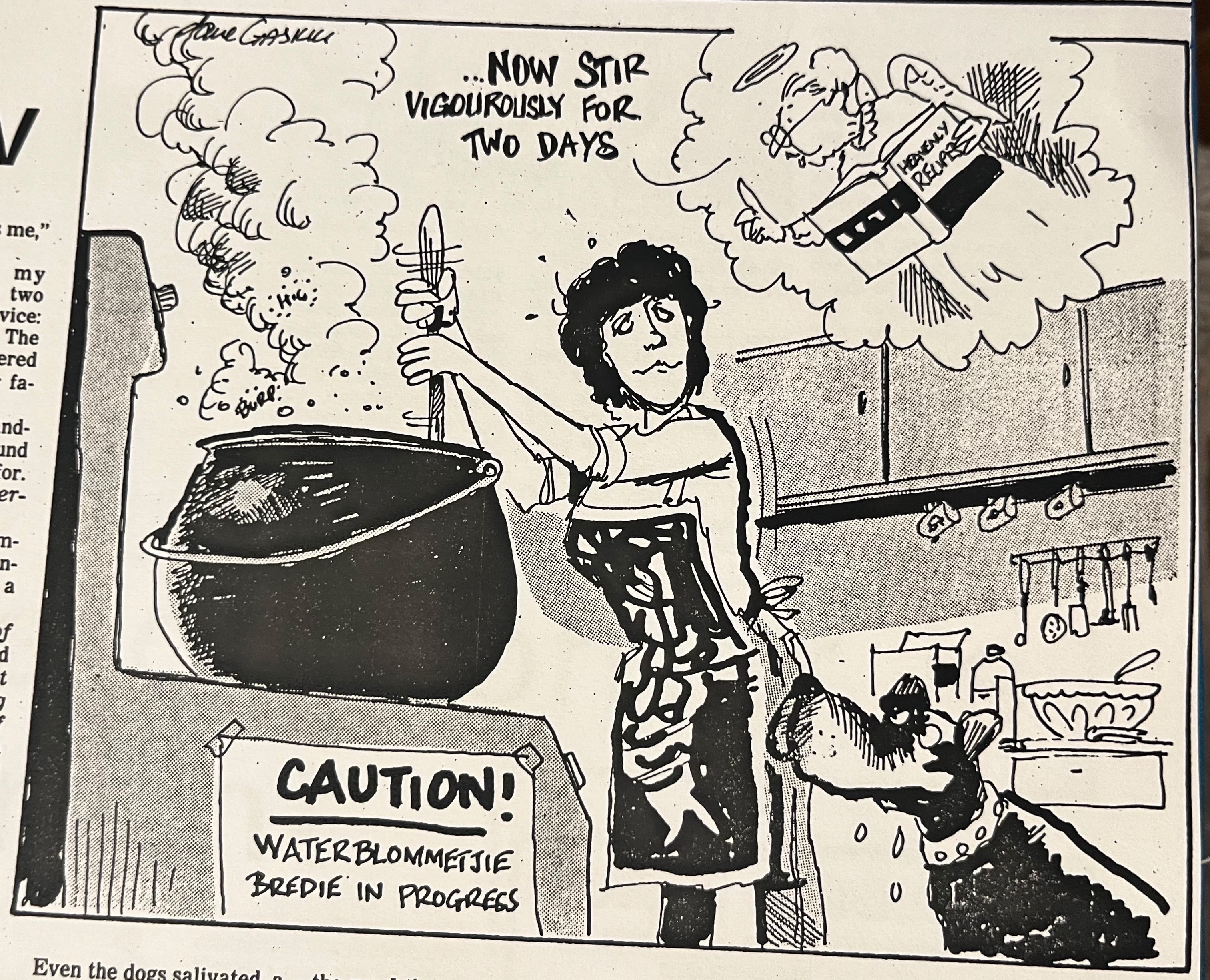
Even now, so many years later, my mouth waters at the thought of that waterblommetjie bredie simmering gently in the big cast-iron pot on the wood stove.
I quickly threw four packets of waterblommetjies into my trolley and made my way to the till.
My family was duly impressed with my acquisition.
“Ma, you know what happens when you experiment with food,” said Ralph resignedly. “In all these years, have you ever had a success?”
“Ungrateful worms,” I growled. “Do you want a dull, uninteresting diet? Do you want to eat chops and chips for the rest of your lives?”
“Yes,” they answered with alacrity.
Sometimes you can't win.
That day, my spouse announced he was bringing two overseas visitors home for dinner.
“Great,” I answered enthusiastically. “I'll make them something traditionally South African.”
“Perhaps we should go out to dinner,” he said. I detected a note of worry in his voice.
“Don't be silly — I'll prepare a meal they'll never forget.”
“That's what worries me,” he said darkly.
When I married, my grandmother gave me two things. The first, advice: “Don't do it,” she said. The second, an aged and battered notebook filled with her favourite recipes.
I paged through the handwritten notes until I found the recipe I was looking for. 'Sannie Retief's waterblommetjie bredie.'
The ingredients were simple enough. It was the quantities that were a bit of a problem.
'Take one heaped pot of waterblommetjies,' she'd written, 'two fat onions, fat for frying, about eight big potatoes, a handful of lemon tree leaves from the lemon tree, a handful of sorrel leaves, some mutton ribs cut up into bite-sized pieces.
'Fry the onions in the fat until bushman brown, then add the mutton and fry that, too.
'Pluck the flowers from the waterblommetjie stems, and remove the stamens. Throw the whole lot into the pot and cook for two days SLOWLY.'
Of course, I actually never did find the stamens of the flowers, so I just threw them into the pot as they were.
For two days, my bredie simmered slowly, wonderful aromas floating through the house.
Even the dogs salivated, a sure sign of culinary success.
Finally, the evening of our Dutch guests' visit arrived.
I laid the table with extra care, using the authentic African made-in-Japan beadwork mats I'd bought at Dion's.
For a centrepiece, I used strelitzias and tulips — I wanted my guests to feel at home.
My husband, resigned to the meal that was to follow, had even given it a bit of a build up, I discovered.
For, when we sat down to eat, our guests Hans and Jan smiled expectantly.
“Rob told us this is a real treat we're having tonight,” said Jan.
“Yes,” nodded Hans, “a truly South African dish, something we've never experienced before.”
Graciously, I dished up my waterblommetjie bredie from the huge, cast-iron pot. It looked, smelled and tasted delicious.
“Outstanding!” said Hans.
“Wonderful! You South Africans certainly know how to cook!” agreed Jan.
Even my spouse was complimentary.
“Carol, this is an amazing waterblommetjie bredie. Even your grandmother would be impressed.”
I smiled and accepted the compliments graciously.
This was not the time to tell my guests that my grandmother would be turning in her grave if she saw this particular waterblommetjie stew.
This was not the time to tell everyone that an hour before our guests had arrived, I'd tasted the waterblommetjie bredie and that my tongue had shrivelled up in horror. It was bitter, sour — in fact, totally inedible, a disaster.
So, as quick as a flash, I'd shot up to the local Chinese take-away and bought vast quantities of Peking duck which I'd then cunningly arranged in the cast-iron pot.
Indeed, what we were at that very moment eating was Peking duck disguised as waterblommetjie bredie.
After dinner, my husband called me aside.
“Carol, that was outstanding. I was so worried. You know what usually happens when you experiment. That was great, you excelled yourself.”
He's right. I did.
■
Editorial note
Masthead reads Sunday Express LIVING, June 10, 1984; no page number is visible. The grandmother’s recipe and its wording are retained.
Transcribed as printed. Doubtful readings:
- “fist bent”: the two words following “supermarket” are indistinct in the small photograph.
- “mosbolletjies”, “hotnotskool stew”, “sand-rietbokkies” and “tzimmis”: the food names are small and indistinct. The line break after “sand-” may be a word division.
- “Tannie Hettie’s tafel”: the grandmother’s name is indistinct.