Carol’s Column
Man on the run
SWEAT pouring down his face, his cheeks puffing, the Anglican Bishop Desmond Tutu, South Africa's Nobel Peace Prize laureate, comes panting up the hill. It's 6am early-morning Soweto time and the riot-torn township has been awake since 3am with grey figures scurrying through the coalstove air to work.
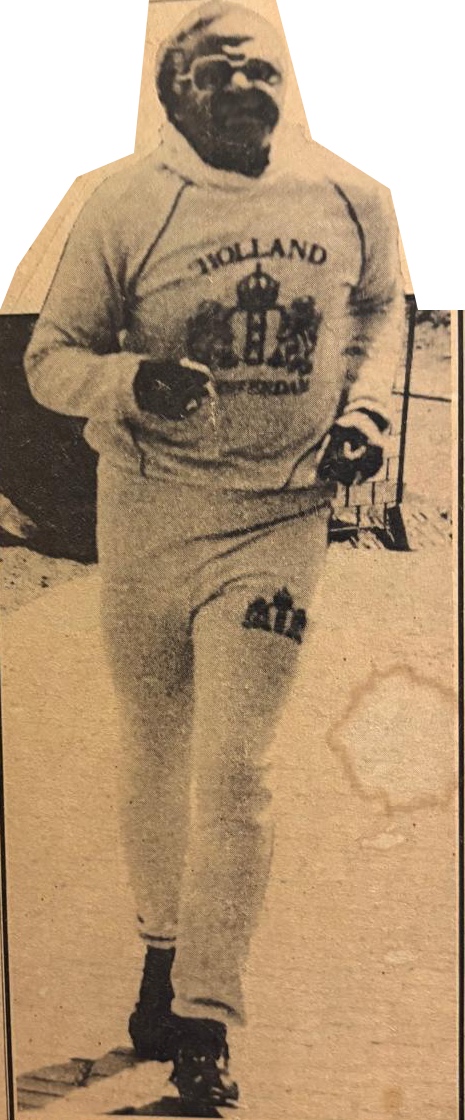
I sit on a white-washed rock, a white in a white skirt, a camera slung around my neck waiting to take a picture of the jogging Bishop. People pass without a second glance. The sight of a white woman sitting on the pavement is no stranger than the casspirs patrolling the streets.
It's just another remarkable incident in the 24 hours that I have spent with the Bishop. I want to get to know this man who is either loved or hated. Who is respected and feted by heads of state and governments throughout the world, yet ignored by his own government back home.
The Bishop of Johannesburg, loved by many blacks but distrusted by many whites, even in his own diocese, has been called a disciple of God, a prophet, a revolutionary, a charismatic leader, an ANC supporter, an anti-Semite, a moderate, an extremist, a political leader, a troublemaker. And much better and much worse.
We meet in St Mary's Church in Jeppe at 8am on Sunday. A tiny church, whitewashed walls, wooden beams, shining gold. The sun tumbles through stained glass windows on to the small multiracial gathering. There used to be a large coloured congregation before they were kicked out of the area, somebody says.
In the pulpit is the Bishop, a small, comfortable figure, his face owl-like behind glasses, his teeth shining white when he laughs, which is often. His sermon is stirring, funny, serious — about peace and love in this troubled land. A young girl is confirmed by the Bishop, her voice bell-like as she responds, her blonde hair creeping under her white veil.
The service is over and the Bishop greets and hugs his congregants. He cares for them and they for him.
Chauffeur
Then it's into what he calls his “Poor man's Merc”, a Toyota with tinted windows and a chauffeur. “For security reasons” says the Bishop. Beethoven blasts through the car. “I love Beethoven, when I travel he washes through me.” Today the Bishop talks, usually he works, meditates or prays while travelling.
“I'm missing my wife a lot,” he says. Leah Tutu is in the States, a guest of the Quakers and accepting an award on behalf of the Bishop. “She was introduced as Bishop Tutu's wife and she stood up and said Bishop Tutu was her husband. I think I've got problems when she returns.” His eyes crinkle and twinkle and his laugh is hearty. He's very proud of Nomalizo Leah to whom he's been married for 30 years.
And then we're in Soweto. Matchbox houses, dirt roads, dust, prowling casspirs, road blocks and children everywhere. St Paul's Church in Jabavu is huge, a concrete structure pilchard packed with worshippers of seven visiting parishes. Four black, three white. Archdeacon David Nkwe and several ministers greet the Bishop who bounces out of the car like a rubber ball, his cassock swirling, his arms windmill whirling. “Greetings, hello,” and “Hi, guys,” to the children that flock to him and tug his robes for attention.
Inside the church you can't fit another person and still they stream through the doors and jostle, crowd, squeeze into the pews. The singing is glorious. It seems the roof will fly to the sky. And then the clerics enter, the Bishop at the back swaying from side to side, his staff waving in time to the music.
Sermon
When Bishop Tutu delivers his sermon, the church hushes. “It's wonderful to see so many come together at a time like this in our country ...” He has extraordinary charisma, this small Bishop with the large voice. Towards the end, many are crying and there are tears in his eyes as he pleads to God for help and guidance, as he prays for peace. “We must love each other. We must care.
“I don't want to see my people killing other people if they are informers. I don't want to see my people's children burning other people's children. I don't want to see my children detained. Let us demonstrate to the world we are praying for one and another. That we are members of one family. The family of South Africa.”
Outside the church, in “Beirut”, the so-called “War zone”, the people are angry, disillusioned, bitter. Yet in St Paul's several thousand multicoloured South Africans have come together to pray for peace.
Then there's a busy, bustling, talking lunch with people eating, meeting and getting to know each other. Like a miniature magnet, the Bishop of Johannesburg wanders, always there for his people — a toothless old woman, doek skew on her head, a blue-rinsed grandmother, a couple in jeans, a snot-nosed kid.
No time
The Bishop hardly eats, there isn't really time with so many people to speak to between each mouthful.
We drive to his house in Westcliff, Soweto. The official Bishop's residence is in the affluent white suburb of Westcliff, Johannesburg. The Tutus spend time in both. “But,” says, “This is my home home.”
En route we talk. “Disinvestment and sanctions are the only way to get any effective change here. The only reason that those businessmen went to see the ANC was because the bottom has fallen out of the rand — it's wobbling. Had the business community listened 10 years ago, it needn't have been like this.
“The government must make a declaration to say they intend dismantling apartheid, that they are not playing games. They must lift the state of emergency, release political prisoners, allow exiles to come back to talk. The ball is in the court of the government and if they don't want civil war, they must talk.”
The Tutus live in one of the better parts of Soweto. “That's probably the safest house in the whole ghetto,” a colleague remarks when he hears I'm spending the night with the Bishop. The house is attractive, the garden neat, with a high wall and a gate that locks.
We enter through the kitchen, bright modern and fully applianced down to the microwave oven. “Tea, coffee?” asks the Bishop, deciding in which bedroom he'll put me. He clucks around, searching for a towel, looking for a light bulb, worried about my comfort.
I'm settled in a room with plenty of books, an oil painting of the Bishop on the floor half obscured by the curtain, a signed Pieter Dirk Uys calendar on the wall. It says “Et tu, Tutu!”
The Bishop excuses himself for a brief nap. “I like to sleep — to sleep and read, when I have time.”
I wander curiously around the house. There's a superb sculpture of Bobby Kennedy's head on the piano next to a small brass lion presented to the Bishop by Leo Marquard Hall of the University of Cape Town.
“Oh, his brother gave it to me,” the Bishop says later when I ask about the Kennedy head. A modest man by nature, text cut off in photograph pression and relentlessly for a new political and moral order.
While the Bishop sleeps, I read in the local diocese paper that there's been a complaint that the Bishop is hardly in his diocese. He repudiates that strongly, stating that in a year he's only been overseas for 28 days, including a trip to the States for his daughter Naomi's graduation.
His second daughter, Mpo, is also studying there.
There was a visit to France to attend a human rights seminar with other Nobel Peace Prize laureates and then another trip to the States to accept the US International Integrity Award. Previous recipients have been Mahatma Gandhi and Sister Theresa.
The son of a schoolmaster father and domestic worker mother has done well.
The Bishop wakes and it's off to pop into his married daughter Thandi and take the Sunday newspapers if she's finished with them.
There's much warmth and laughter in this small household. “Did you go to church this morning, Thandi?” he asks smilingly. “Aw, come on Daddy, give God a break!” his daughter replies with a grin. The Bishop is known for his irrepressible humour and it spills from him all the time. In church he lightens a sermon with a joke. He's always telling stories against himself ... “Did you hear the one about P W Botha, Pik Botha and Bishop Tutu ...?”
“My children keep me sane,” says the Bishop on the way to St Peter's Priory in Rosettenville to visit a sick priest. Desmond Tutu studied here, as did ANC leader Oliver Tambo. Over the years, the Tutu family have been harassed and abused. Leah Tutu has been attacked, his son Trevor arrested, his daughters teargassed. “They try to get at me through my family,” he says angrily.
Crazy
We visit the “posh” house in white Westcliff to fetch a robe. It's grand, spacious and gracious. “You could put 10 Soweto homes in the front garden,” the Bishop says chirpily. “A crazy country this.” He says this often during the two days I spend with him.
He bounds upstairs. A row of Bishops gaze down from dark frames. “The rogue's gallery,” he mutters. “My dresses text cut off in photograph
I'll see them. Here I cannot see the State President.
“I'd seen P W before in a big delegation. It was a waste of time. I wanted to talk to him on a one to one basis as human beings, as South African to South African, as grandfather to grandfather. It would have been an engagement of minds.”
Vanderbijlpark, a neat town of tidy houses and white civic might within hailing distance of Sasolburg where the CP are newly victorious, is expecting the Bishop. Father Rob Jobling has received a call from the security branch because it seems the visit of the Anglican Bishop has aroused much interest. A black dignitary who is also a Nobel prizewinner has put the town in a spin.
The church is full, the tea afterwards, a warm, mainly white and wonderful affair. The Bishop speaks English and Afrikaans as he greets his flock. His energy is endless, his merry, exuberant personality fills the small hall.
Bishop Tutu's attitude to violence is an evocative emotional issue among many whites. “He's a churchman but he's not a pacifist,” his critics howl in anger. “He justifies the use of violence to achieve the ends,” they say.
No, the Bishop is not a pacifist. A pacifist says there are never ever circumstances that justify being willing to kill.
“Apartheid is violent,” states the Bishop. “I oppose violence but I accept there may come a time, because of an unjust system, when all else has failed, that the church might say to its members it is justifiable to fight against an unjust system. Which is the lesser evil? The evil system or the fighting against it, as for example the fight against nazism.
“Before that, there are several clear criteria you apply to justifiable revolution. Have you tried every method short of violence to change the system? Is your objective just? Will the thing you replace an unjust system with be better?
“The Church can never espouse violence. Christians must make up their own minds. But violence can happen when you hurt inside and you have been made to feel less than human.”
The Soweto roads are ink dark. We see the lights of a roadblock in the distance.
We pop into good friends for a chat and a Coke. And then it's home in time to beat the 11pm curfew.
“Come and look,” the Bishop says peering through the drawn curtain, “It's just on 11pm, see how the cars are speeding to beat the curfew.” Like arrows, the lights streak through the night.
I ask him to show me his Nobel prize. After scratching through his bedroom drawers, he emerges carrying a few boxes. The Nobel Peace Prize is impressive, a gold medal with slender figures on the one side and Alfred Nobel's head on the other. The elaborately printed citation is equally impressive “Den Norske Nobelkomite, Nobels Fredspris 1984, Desmond Mpilo Tutu”.
Although he is reluctant to admit it, it still hurts that when he received the Nobel Peace Prize, although honoured by the rest of the world, the official silence in his own land was deafening.
He has received so many awards that they'd fill several display cabinets if he let them. But that's not Desmond Tutu's style. He keeps most of them tucked away somewhere.
Later, I brush my teeth to the silence of a still Soweto night. The night before there'd been shooting and noise, it kept the Bishop awake.
I sleep like a log and awake in time to hear the Bishop leaving for his early-morning jog. He runs at 5am every day except on Mondays when he “Sleeps in” and runs at 6am. He offers me breakfast but skips it himself: “I never eat it” — and we leave for the early-morning service at the small church up the road.
The Bishop is in his office at 7.30am during the week, except Mondays, his day off. This he spends at home, praying, meditating, relaxing, sleeping, reading.
On the day I spent with the Bishop at his office, after personal prayer, he led the diocese staff in prayer, then followed non-stop meetings throughout the morning until 1pm. text cut off in photograph
■
Editorial note
This transcription is incomplete.
The printed masthead reads Weekend Argus, November 16 1985, page 15. The strapline reads “Carol Lazar spends a day with the bishop who talks to kings and still cares about the little things”. This is a reported profile, not a Carol's Column instalment. Transcribed from overlapping photographs, pages 835–856. Three passages are incomplete: the discussion following the Kennedy sculpture, the end of the section headed Crazy, and the final office visit and farewell. Cropped fragments are retained where legible, with gaps marked. The two pull quotes repeat body text and are not repeated in the transcription. “Westcliff, Soweto”, “Mpo”, “Sister Theresa” and “swops” are retained as printed. The jogging photograph is cropped from page-835; surrounding headline and type are masked away without reconstructing photographic detail. No photographer credit is visible in the clipping. Photo source credited to Carol Lazar as supplied by the family.
Transcribed as printed. Doubtful readings:
- In the St Mary's Church paragraph, the left edge cuts into 'gold'; the surviving letters and sentence support that reading.
- Missing text follows 'A modest man by nature'; it resumes with the end of a word, 'pression', whose beginning is not visible.
- The Crazy section loses text after 'My dresses'; the next column resumes 'I'll see them'.
- The last office-visit paragraph and farewell are cropped on the right in the available close-ups.